



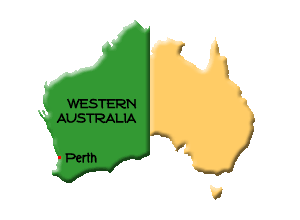
Click on the images to ENLARGE.

 Western Greys
What is a kangaroo?
Kangaroos are marsupials (pouched) belonging to the macropod (large foot) family.
The name kangaroo is generally used for the larger members of the kangaroo family, while the smaller species are usually called wallabies.
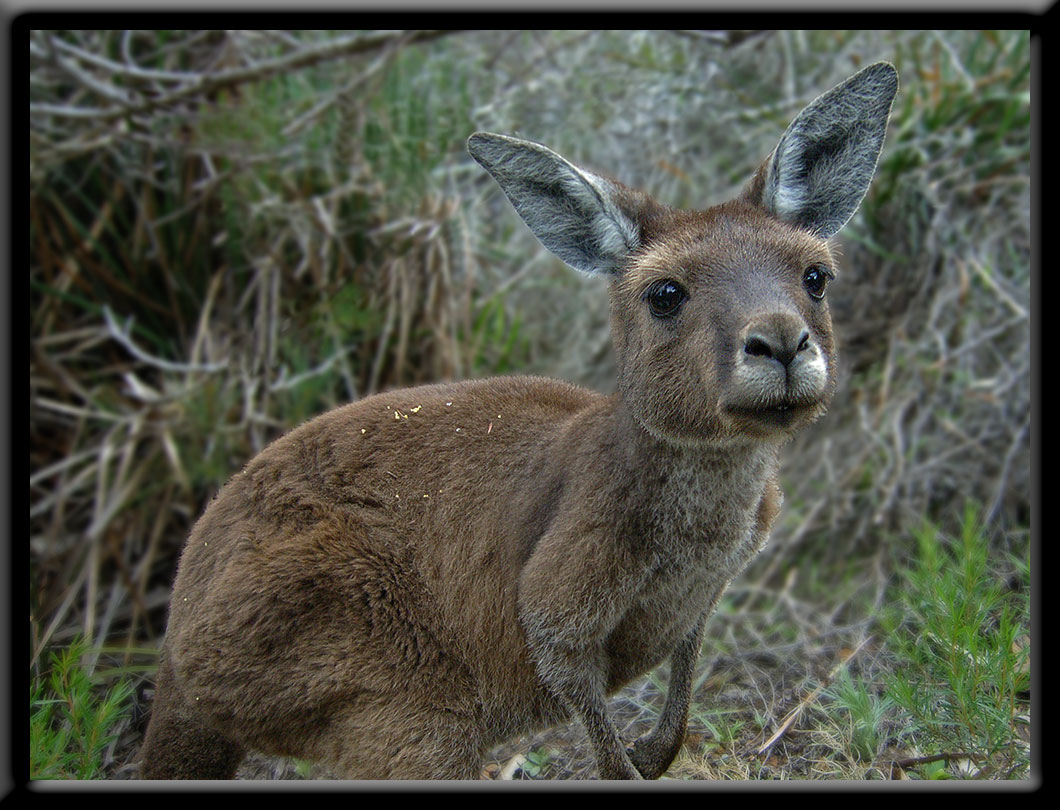 Curious Joe
Four species of large kangaroo live in Western Australia:
 Rufus The Red
RED KANGAROOS
Osphranter rufus
live in central and inland Australia.
Their colouring matches the red soil of the Outback, giving natural camouflage from Dingoes and Eagles.

Standing taller than man, they are Australia's largest land animal.
 Fuliginosus the Grey
WESTERN GREY KANGAROOS
Macropus fuliginosus
can be found in the southern half of Western Australia.
These friendly, good-natured herbivores are mainly nocturnal.
Male greys grow to 70 kg — females 35 kg.
 The Euro
EURO
Osphranter robustus erubescens
These stocky, shaggy kangaroos are found all over WA except the lower south, usually in hills and ranges.
Euros have very solid shoulders and forearms, shorter hind legs and large, expressive ears.
Can be mistaken for a Red Kangaroo.
 Two Roos
Kangaroos are one of the most abundant large wild land mammals on earth.
Current populations stand around the 50 million mark.
But, the chances are you may never see a wild kangaroo unless you drive in the country at night or visit a golf course.
 Exmouth
Kangaroos are good swimmers and will kick each leg independently.
On land their hind legs can only move together.
 Joey
JoeyDesert kangaroos can have three babies at the same time:
She can be pregnant for all but one day of the year — the birth day.
 Alert
Alert Spot the Roo
 Bounder
Hopping is extremely efficient.
At 35 km/h, a roo can outlast a chasing dog because it uses oxygen very efficiently.
This is due to the special geometry of the legs and the large stretchy tendons that store energy.
Also, because of this superb design, little extra energy is used when a kangaroo increases its speed.
 Jack, Jill 'n' Joey
Male kangaroos are generally known as bucks but the large specimens, and leaders of the mob, are called boomers.
Females are usually called does, and the young are joeys.
 Western Grey
Fun facts:
A kangaroo uses its tail as a fifth-leg tripod.
A kangaroo can reach speeds of over 60 km/h when hopping.
There are probably more than twice as many kangaroos in Australia than people.
A newborn kangaroo is only about the size of a jelly bean.
 Bouncers
 Walk on the Beach
 You Beauty
A kangaroo kept getting out of his two-metre enclosure so a five-metre fence was put up. Again he got out.
When the fence was ten metres high, a dingo in the next enclosure asked the kangaroo, "How high do you think they'll go?"
The kangaroo said, "About 100 metres, unless somebody locks the gate at night!"
 Roo Roo
Roo roo - look at you
Hopping through field and bush.
Along you go... fluidly bounding
Natural ease... so astounding.
The speed and grace
Of your amazing pace
Is truly poetry in motion.
I would love to do so too!
 Greys
GreysHandy Bushman's Trick #72.
An easy-to-find compass if you are lost.
To cool down and escape from the hot Australian sun, a kangaroo will hollow out the ground under a big shady bush on the south side.
 Roo Family
 Natural
 Kangaroos Ahead
Warning signs are common in kangaroo country.
Night-time driving on the open road can be a nerve-wracking experience,
especially after spotting your first kangaroo.

From that time on, imaginary roos are everywhere.
Thousands of collisions between motor vehicles and kangaroos take place every year.
 Fish Head
Kangaroos are herbivores... usually.
This roo was foraging in the seaweed along the beach and sniffed out a fish head.
He munched and chewed on it for about an hour and returned the next morning to finish it off, until only scraped bones remained.
 Skinny Roo
 Caution
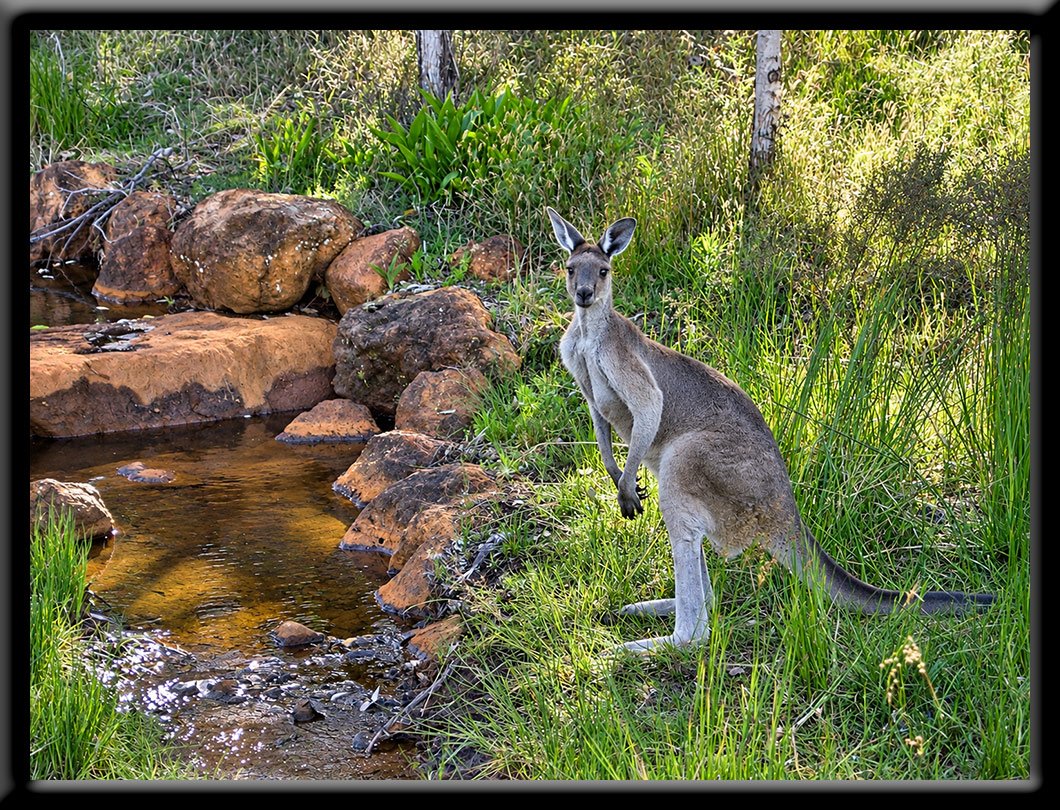 Kanga
Kanga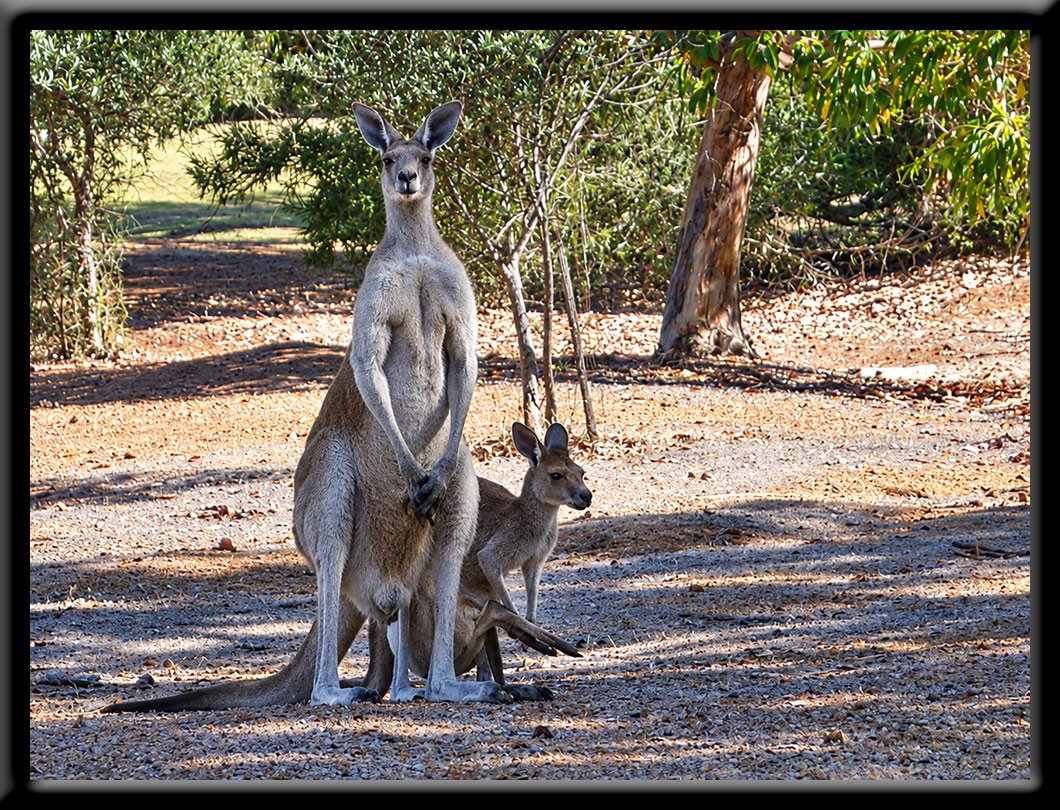 Boomer


Some information on this website dates back many years and may have changed or been updated since publication.
All pics taken by  Ray
and copyrighted 2003 - 2026.
Ray
and copyrighted 2003 - 2026.